Frase Review (2026): Good Brief, Needs a Human Editor
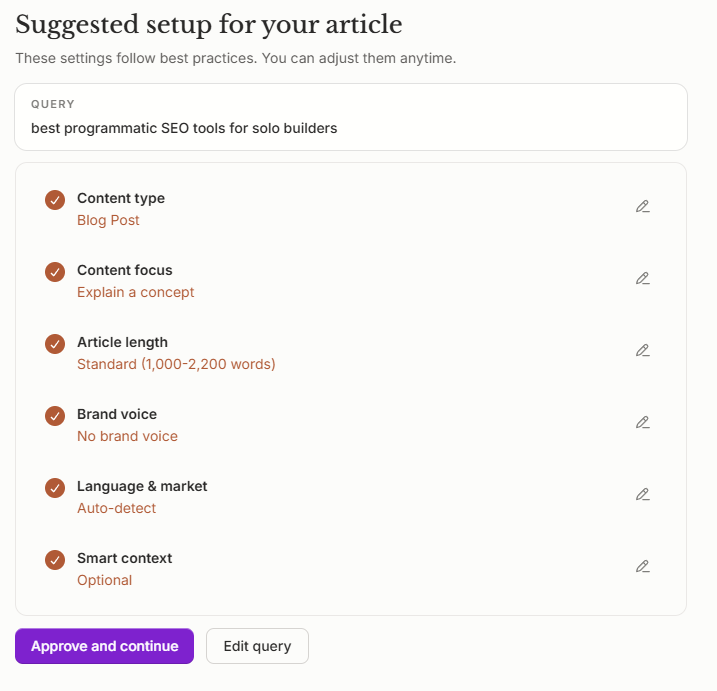
We signed up for Frase’s free trial and ran it against a real keyword we’re targeting on this site: “best programmatic SEO tools for solo builders.” No credit card was required, and the workspace was ready in about five minutes.
What worked well
-
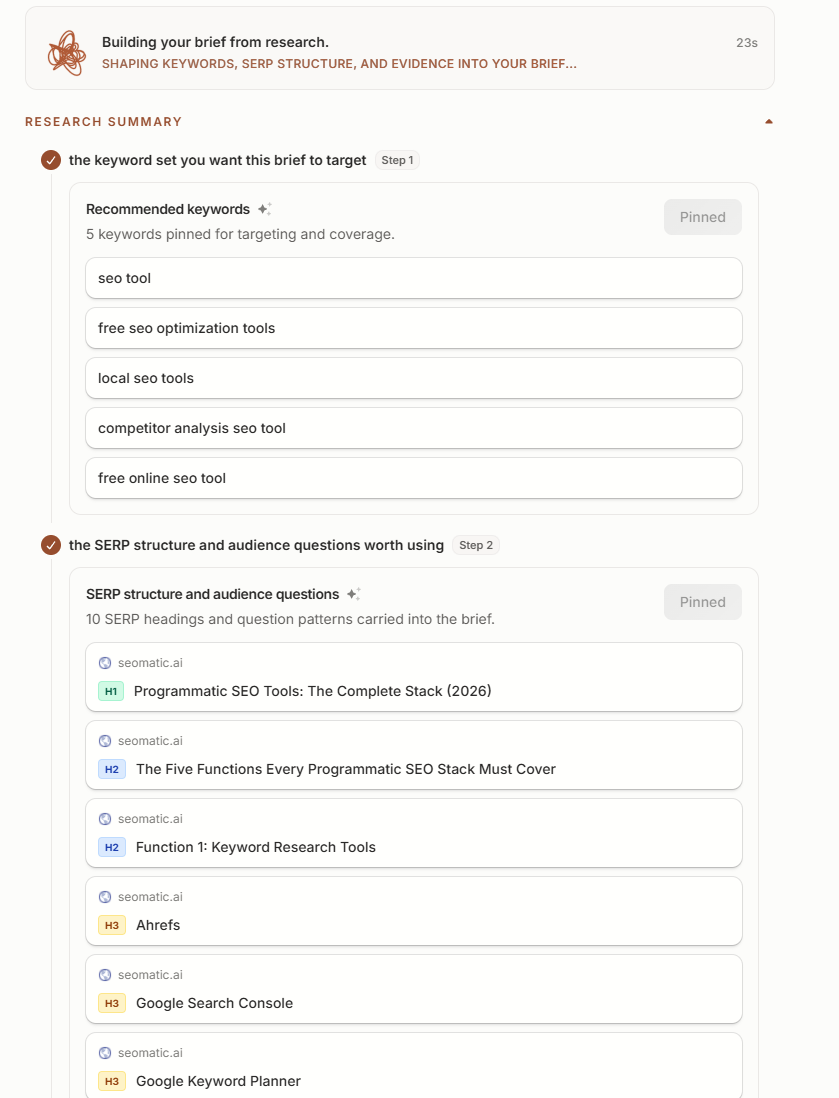
Keyword expansion was solid. Frase suggested five related keywords, four of which were genuinely on-target for a solo-builder audience (
programmatic seo software for solo builders,no-code programmatic seo stack,how to build programmatic seo sites,best programmatic seo tools). One suggestion (best seo software for agencies) missed the audience entirely. -
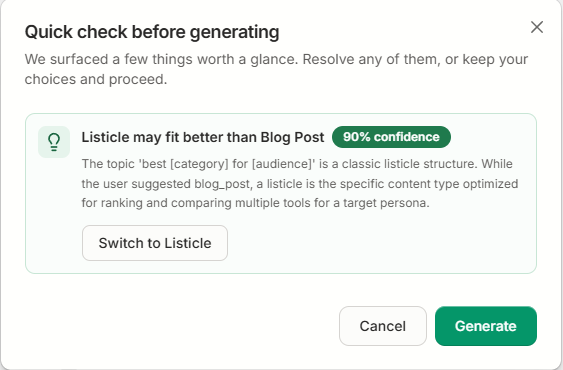
It caught a format mismatch we didn’t specify. We asked for a “Blog Post,” and Frase flagged — with 90% confidence — that a listicle format would perform better for this query, and explained why. That’s a genuinely useful check, not just a template swap.
-
It pulled real competitor structure. The brief included actual headings from currently-ranking pages (seomatic.ai, slatehq.com), which is a legitimate shortcut for outlining against what’s already working in the SERP.
-
The AI-citation visibility feature is interesting. Frase showed how often AI platforms like Gemini and Perplexity cite sources for this exact query (35 sources, 46 citations, zero named competitors dominating the answer) — useful signal for judging whether a keyword angle is already “claimed” by someone else.
What we would not publish as-is
The generated brief built its entire opening thesis around one statistic: that a traditional SEO agency costs “$8,500 per month,” framing our target tool stack as the cheaper alternative. The brief cited exactly one source for this — a blog post from a company (BlazeHive) that publishes the same kind of listicle content we were about to write.
We checked this independently. Industry survey data (Ahrefs polled 439 SEO professionals) puts the average agency retainer closer to $3,209/month, and most small businesses pay in the $500–$5,000 range. $8,500/month is a real number, but it sits at the high end reserved for nationally competitive, high-stakes industries (legal, finance, real estate) — not a representative cost for the solo-builder audience this article was supposedly written for. Frase didn’t fabricate the number, but it selectively picked the most dramatic figure available and presented it as the norm.
We also noticed:
- One recommended tool (“theStacc”) was sourced entirely to that tool’s own marketing site — a vendor’s claim about itself, presented in the brief as neutral fact.
- Another recommendation (Byword) was sourced to “Gemini AI Visibility” — in other words, the evidence was “an AI said this,” not an independent citation.
- The brief explicitly instructed: “Don’t suggest manual content creation as a viable alternative for this specific audience.” That’s a directive toward a persuasive, one-sided narrative, not a balanced one.
None of this makes Frase useless — it means the output is a draft to interrogate, not a draft to publish. Every “FACT” and “STAT” in a Frase brief needs a human to check the source before it goes live.
The Site Audit turned up a real bug on our own site
Frase’s onboarding drip nudges you to run the Site Audit (automatic SEO issue detection, keyword
cannibalization checks, content decay flags) before your trial ends. Our first attempt hit a wall:
the trial only allows one site, and it had already auto-registered our Cloudflare Pages default
domain (solo-stack-lab.pages.dev) as that slot. Trying to add a second site — even just to point
the audit at our actual custom domain — triggered a “Keep going on Professional” upsell for
$129/mo before we could so much as configure the audit. Same shape as Surfer SEO’s paywalled
Auto-Optimize button and SE Ranking’s paywalled Site Audit detail: advertised as part of the free
trial, gated the moment you try to use it realistically.
Running it against the already-registered domain instead (no upgrade needed) produced a usable
result: 45% overall score across 15 of 16 pages, with 6 site-wide findings. Two of them
(“Mismatched Canonical URL,” “Invalid Sitemap,” both firing on 100% of pages) turned out to be
artifacts of auditing the Pages.dev domain instead of our real one — expected noise, not a real bug.
But “Missing OG Image,” also firing on 100% of pages, was real. We checked our own layout code
and confirmed it: every page had og:title, og:description, and og:url tags, but no og:image
— meaning every link to this site shared on social media would have rendered without a preview
image. We’d documented “proper social-share previews” as done in our own project notes back on Aug
15; the audit caught what we’d missed. Fixed same-day (see below).
That’s the honest tension with Frase’s Site Audit: the feature itself is trial-gated behind a paywall for any domain other than your first one, but the one free audit you do get can genuinely catch things a human skim of your own site won’t.
Bottom line
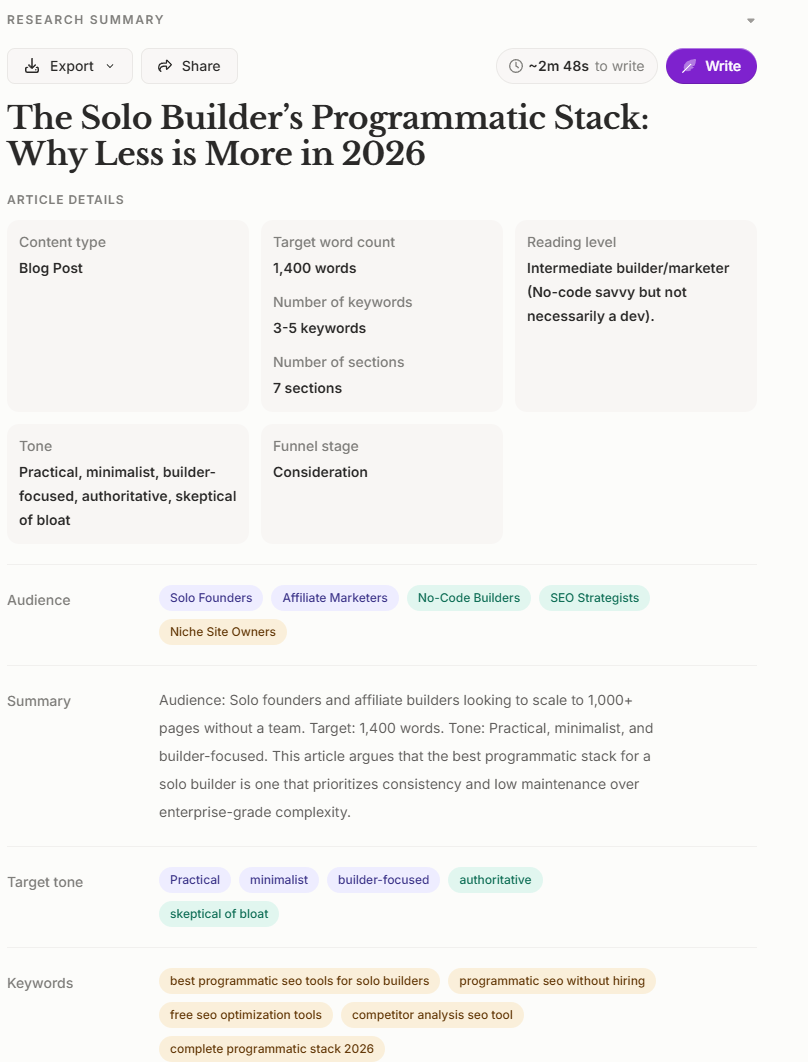
For the research and outlining stage — keyword expansion, competitor structure, format recommendations — Frase saved real time and the suggestions were sound. For anything presented as a fact or statistic, treat it as a lead to verify, not a citation to trust. We’ll keep using it for stage 1–2 of our content pipeline (see our AI content pipeline guide), with firsthand verification remaining a mandatory separate step before anything ships. See our Frase vs Surfer SEO comparison for how it stacks up against Surfer’s post-writing audit approach.
This is an affiliate link — see our disclosure policy.