Surfer SEO Review (2026): Real Keywords, Real Dark Patterns
We signed up for Surfer SEO’s Discovery plan and ran its Content Editor against a real, already-published page on this site — our Make vs n8n comparison — to see what it would actually tell us to change.
The “Start for free” button isn’t free
The homepage CTA says “Start for free.” Clicking it leads straight to a paid signup: the Discovery plan charged $59/month immediately (or $49/month if paid annually), with no free tier and no trial period — only a money-back guarantee, which we’ll come back to. This is worth naming plainly: “free” was not an accurate description of what we clicked.
What it got right: entity research from real competitor pages
We imported our own article, and the Content Editor smartly auto-detected “Comparison” as the right content template just from the query “make vs n8n” — a nice piece of pattern recognition, similar to what we saw from Frase’s format detection.
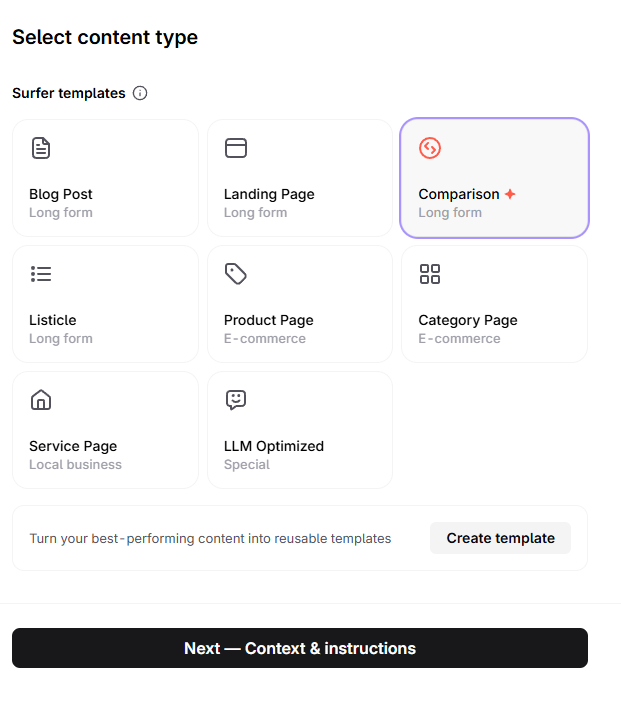
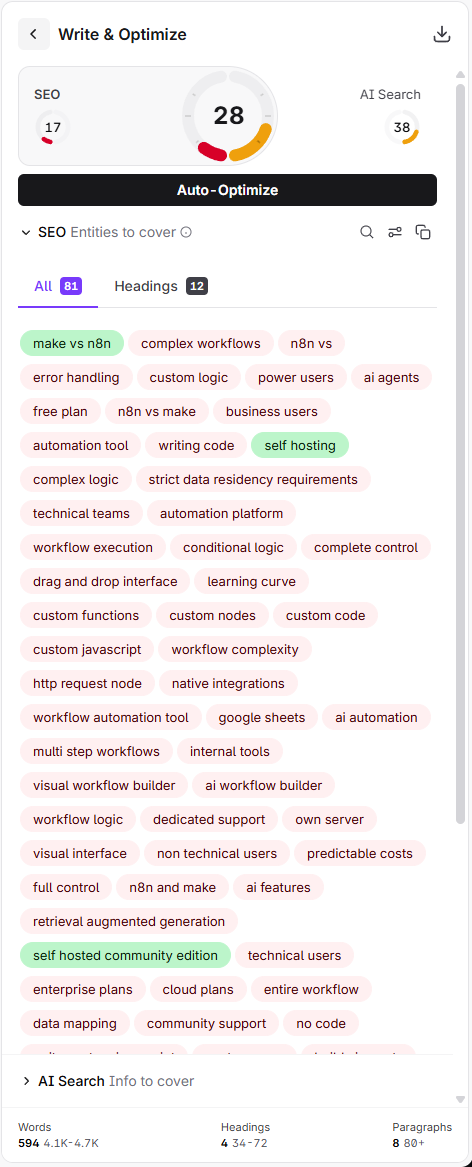
More useful: the “SEO Entities to cover” panel pulled 81 specific terms used by currently-ranking competitor
pages that our article doesn’t use — things like http request node, retrieval augmented generation,
vector databases, and strict data residency requirements. This is genuinely actionable keyword research,
not filler.
What it got wrong: scoring that rewards bulk, not substance
Our actual article — 594 words, 4 headings, deliberately concise because it’s built entirely from firsthand test data with nothing padded in — scored 17/100 SEO, 38/100 AI Search, 28/100 overall. Surfer’s targets for this exact keyword: 4,100–4,700 words, 34–72 headings, 80+ paragraphs.
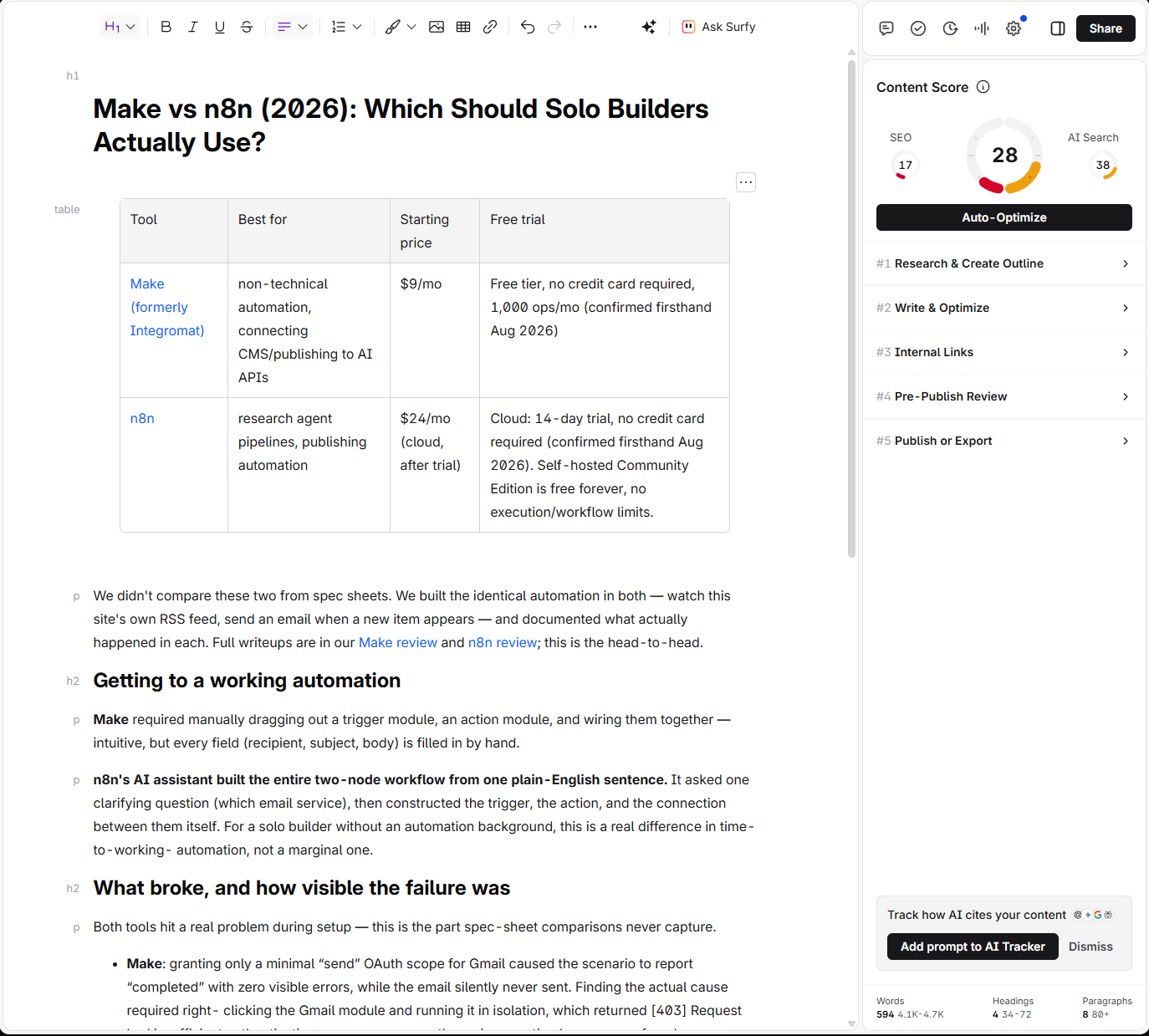
That’s not a minor gap — it’s asking for an article seven to eight times longer than the one we deliberately wrote to avoid padding. Surfer’s scoring is built to match the length of whatever’s currently ranking, and if the pages currently ranking are themselves bulked-up AI listicles, the tool will score a genuinely concise, substantive article as “worse” than they are. Worth knowing before you let a Content Score dictate how long your article needs to be.
A locked button presented as available
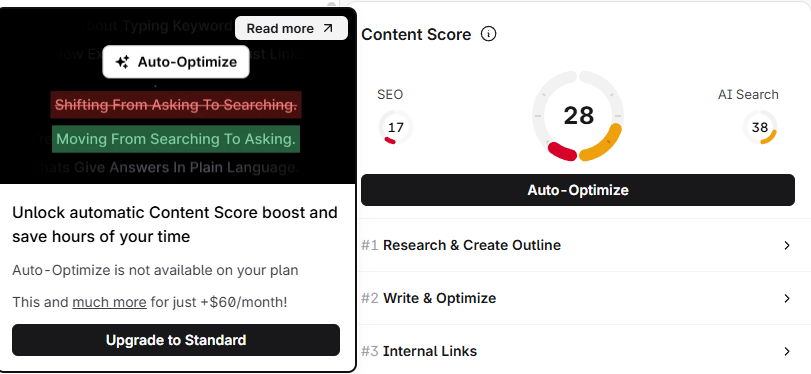
The Content Score panel prominently displays an “Auto-Optimize” button. Clicking it on the Discovery plan returns: “Auto-Optimize is not available on your plan… upgrade to Standard for +$60/month.” The pricing comparison page does list this correctly (Discovery lacks “1-click Content Optimization”), but the button itself gives no visual indication in the editor that it’s locked until you click it.
The refund guarantee we couldn’t actually confirm
Several SEO/affiliate blogs describe a “7-day money-back guarantee, no ifs, no buts.” We checked Surfer’s own official pricing page directly before relying on that claim (a lesson from the first time we didn’t do this — more below): it describes disabling auto-renewal and retaining access through the paid period, but does not state an explicit refund guarantee. Refund requests are directed to email support, which suggests it’s handled case by case rather than contractually guaranteed the way the third-party summaries imply.
We disabled auto-renewal and emailed support requesting a refund the same day. If you’re testing this yourself, don’t assume the refund is automatic or certain — budget for the possibility that you keep the $59/month charge for the period you signed up for.
A note on how we got here
We initially recommended signing up based on the refund guarantee repeated across several third-party blogs, without checking Surfer’s own page first — the exact mistake this site’s editorial rule exists to catch in other companies’ marketing claims. We’re noting it here rather than quietly fixing it, because it’s a useful reminder that “multiple sources say the same thing” isn’t verification if those sources are copying each other.
Bottom line
The entity/keyword research is the real value here, and it’s genuinely useful. But go in with clear eyes: the signup flow oversells “free,” a plan-locked button is presented identically to an available one until you click it, and the refund guarantee that’s widely repeated online isn’t something Surfer’s own page actually commits to in writing. See our Frase vs Surfer SEO comparison for why we use this as a post-writing audit rather than a substitute for Frase’s brief-stage research.